.svg)
.webp?width=300&name=11_Banner%20Image%20(1).webp)
Insight is only the starting point. Alignment determines what happens next.
After results are shared, the pattern is familiar. Conversations loop back. Interpretations differ. Priorities compete. Actions are identified and then stall before real momentum builds.
The insight is clear. The path forward requires alignment.
For global suppliers and retailers managing complex B2B relationships across markets and functions, this gap carries a real cost. Not just in time, but in confidence. When teams interpret the same insight differently, progress slows, and decisions lose momentum before they take hold.
The Questions That Slow Decisions Down
Most reporting provides a clear view of performance: where things stand and how they’ve changed.
But the questions that create real friction are harder to answer:
- Which feedback should we act on now?
- What are top performing partners doing differently, and can we replicate it?
- If we invest here, what changes, and what doesn’t?
- Are we aligned enough to commit resources?
These questions sit between the report and the decision, and in large, distributed organizations, they are often answered inconsistently, or not at all.
This is where momentum slows. As a result, teams revisit the same questions repeatedly, across markets, functions, and cycles.
.jpeg?width=900&height=600&name=compressedImage%20(4).jpeg)
The Shift That Changes Everything
One pattern comes up consistently in conversations with supplier and retail leaders: they don’t need more information. They need shared agreement that something is worth acting on, and the confidence to move quickly once it is.
This is not a data access problem.
It’s an alignment problem. A confidence problem. And often, a gap between insight and how it connects to priorities, trade-offs, and outcomes.
The insight may be available, but until it is clearly connected to strategic priorities, it doesn’t fully land with decision-makers.
When those gaps close, momentum follows. Teams spend less time interpreting and more time executing. Decisions are made with clearer ownership and stronger evidence. Action becomes a natural continuation of insight, not a separate step.
What This Looks Like in Practice
The most effective organizations have changed how they work with insight: not as a periodic report to review, but as a continuous capability that supports decisions as they happen.
In practice, that means:
-
Reducing the manual effort required to identify signal in large volumes of feedback, so leaders aren’t reading hundreds of comments to understand what matters.
-
Benchmarking performance against what top‑performing business partners do define what “improvement” looks like.
-
Modeling the potential impact of decision before committing time or budget.
-
Converting insight into clear, aligned actions with defined ownership and timelines.
In other words, insight doesn’t stop at visibility. It drives execution.
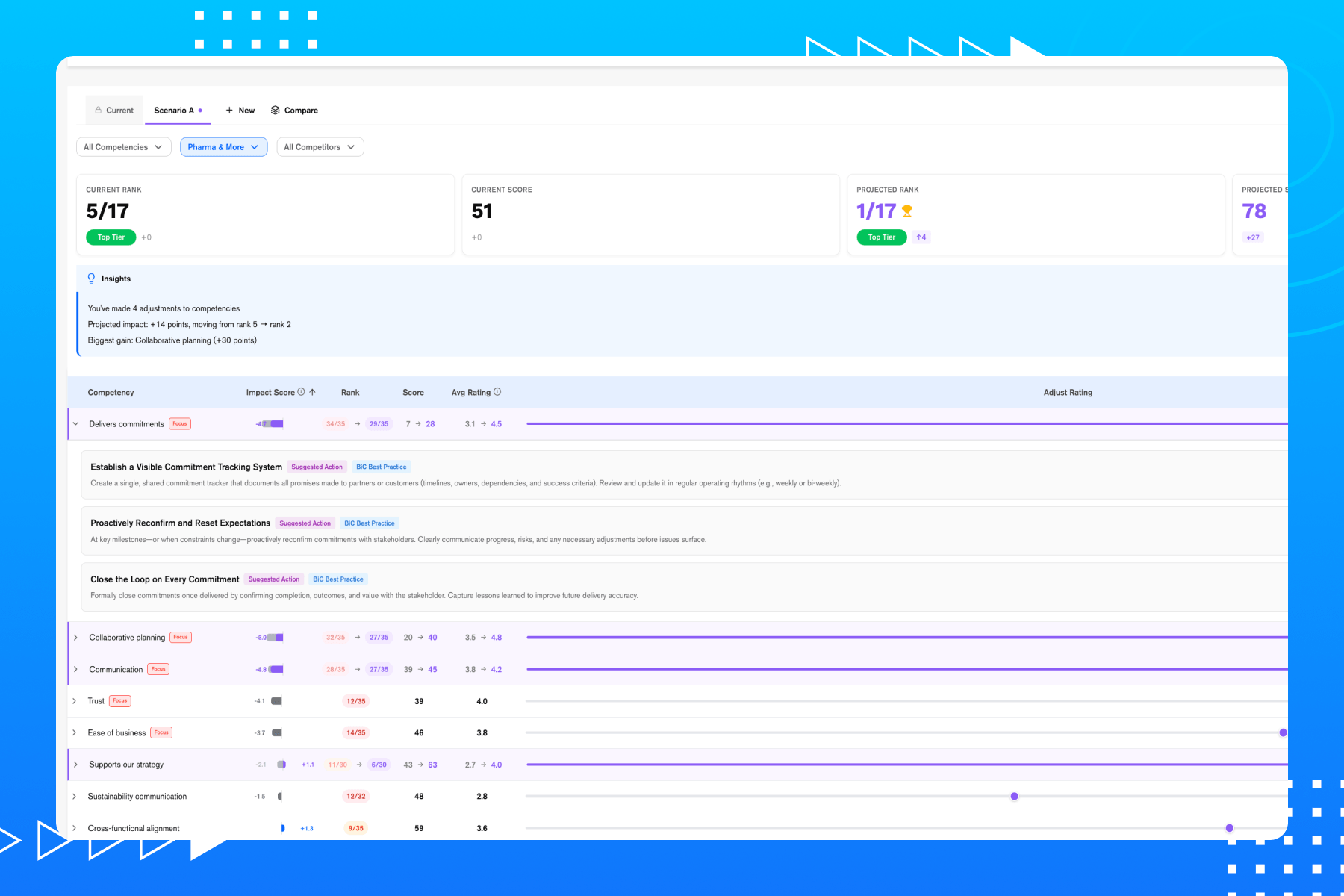
Where Advantage LiveLens Transform Fits
Advantage LiveLens Transform is built for the moment where insight alone is not enough – when teams need to decide what to do next.
It brings structure and clarity by helping teams understand what drives performance, compare priorities to top-performing partners, and explore potential outcomes before committing resources.
Going beyond interpretation, LiveLens Transform connects insight to decision, providing direction teams can align around, in the language leadership uses to set priorities, evaluate trade-offs, and act with confidence.
The result is faster alignment, clearer direction, and greater confidence in what comes next.
Insight Is Only the Starting Point
The standard for performance intelligence is shifting.
The organizations pulling ahead aren’t just measuring more effectively. They’re deciding faster, aligning earlier, and executing with greater confidence.
Because insight only matters when it leads to decisions teams can act on.
See how this comes to life in practice: explore the LiveLens Transform demo or connect with an Advantage Advisor.