.svg)

Business-to-business (B2B) partnership excellence doesn’t emerge overnight. It’s not defined by a single initiative or moment of alignment. It’s shaped over time, through the way your organization operates in the partnership: how you plan, how you deliver, and how you respond when things don’t go as expected.
In most organizations, the difference between an average partner and an exceptional one isn’t intent, it’s consistency. It’s the small, everyday behaviours that determine how easy you are to work with.
You see that consistency become visible in familiar ways: how strategy is aligned, how execution is delivered, how commercial performance is managed, and how consistently teams work together across the business every day.
These moments, often small, sometimes critical, collectively shape the experience of working with you as a business partner.
Understanding Your Path to Excellence
The Path to Excellence provides a way to understand how your organization’s behaviour shapes partnership performance over time.
Rather than capturing performance at a single moment, the Path to Excellence focuses on how progress builds, or breaks down, through how your teams operate day to day: how issues are handled, how reliably you deliver on commitments, and how confidently you work with your business partners on what comes next.
Matt Incles, Vice President, Research, Advantage Group International
These changes aren’t isolated to one part of the business relationship. They show up across four core areas: strategy and alignment, execution, commercial performance, and day-to-day ways of working. Each reflects progress differently, but together they reveal how consistently you operate as a partner.
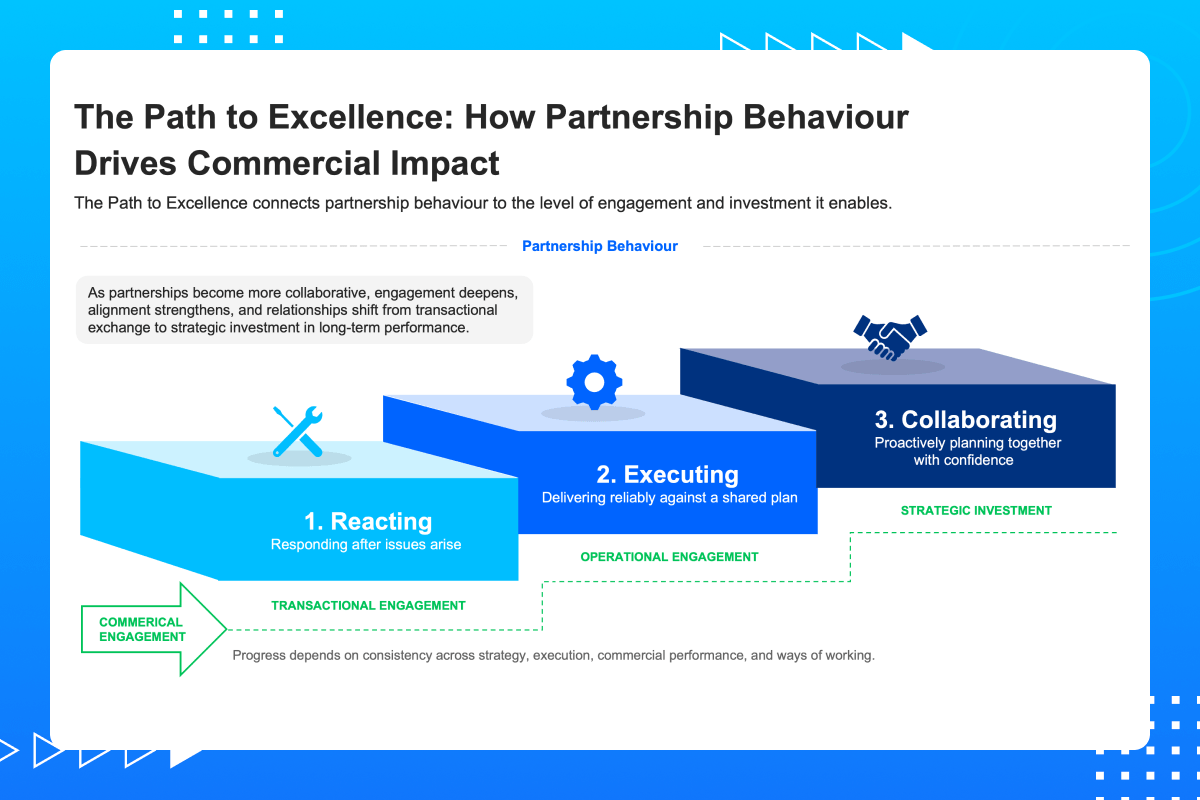
This perspective is grounded in real-world behaviour; built on 14 core partnership competencies that Advantage has measured and observed across manufacturer–retailer relationships over time.
In practice, progress takes shape through three distinct patterns, moving from reacting to executing reliably, to collaborating proactively, each stage strengthening how you operate as a partner.
1. Reacting
At the early stages of B2B partnerships, you may find yourself operating in a reactive mode.
Your teams spend much of their time responding after issues arise: managing last-minute changes, navigating misalignment between strategy and execution, and addressing day-to-day disruptions.
At this stage, expectations may be unclear or applied inconsistently. Information arrives late, priorities shift frequently, and decisions are made under pressure. While effort is high, execution can feel fragmented and disconnected, with your teams and business partners operating in parallel rather than in full alignment.
Reacting can keep things moving in the short term, but it often comes at a cost: increased friction, limited visibility, and a persistent sense of being one step behind—without being truly aligned.
2. Executing
As business partnership build consistency, execution becomes more reliable.
Expectations are clearer, roles and accountabilities are better defined, and delivery becomes more predictable across teams.
Your operating routines begin to support progress rather than create friction. Information flows more consistently, commercial discussions are more grounded and transparent, and fewer issues escalate unexpectedly. Your teams spend less time course-correcting and more time delivering against agreed plans.
The partnership becomes steadier and more dependable. Your energy shifts away from constant problem-solving and toward performance, continuous improvement, and delivering on shared business objectives.
At this stage, the focus is on reliability, ensuring that commitments are consistently delivered and that the B2B partnership operates with discipline and follow-through.
.jpeg?width=900&height=600&name=compressedImage%20(3).jpeg)
3. Collaborating
At the most advanced stage of B2B engagement, you move beyond execution to proactive collaboration.
You anticipate what lies ahead, identify risks earlier, and adapt as conditions change before issues impact performance.
Consistency creates confidence and enables stronger forward planning. Strategy conversations happen earlier and with better alignment. Execution is guided by forward-looking insight, and commercial decisions reflect a clearer understanding of trade-offs and long-term impact. Your ways of working support open dialogue, trust, and shared ownership of outcomes.
The partnership becomes more resilient and efficient, shifting from reacting to issues to anticipating them, using insight and alignment to shape outcomes, not just manage performance.
Across each of these stages, the underlying driver remains the same. Progress along the Path to Excellence is shaped not by a single initiative or moment of alignment, but by sustained effort to strengthen partnership behaviours across strategy, execution, commercial performance, and ways of working.
Looking Ahead on the Path to Excellence
What ultimately differentiates strong business partners from the rest isn’t ambition. It’s consistency.
Not just in plans or processes, but in how your organization operates day after day across strategy, execution, commercial performance, and ways of working.
As these behaviours become more consistent, friction fades, clarity improves, and progress becomes easier to sustain. Most importantly, trust begins to build.
The Path to Excellence provides a practical a way to understand that progress. It shifts the focus away from static evaluation and toward continuous improvement; helping you see where consistency is building, where it’s breaking down, and what it will take to move forward.
In an increasingly complex retail environment, that perspective matters. When your organization strengthens how it operates as a business partner, you are in a better positioned to anticipate change, reduce inefficiencies, and drive sustained performance.
Ready to understand how you engage as a partner? Your Advantage Advisor can help.