.svg)
.webp?width=300&name=08_Banner%20Image%20(2).webp)
China’s fast-moving consumer goods (FMCG) market is at an inflection point. Operationally, it’s one of the most advanced and efficient retail ecosystems in the world, defined by strong execution, scale, and digital maturity. Yet as the market evolves, new pressures are emerging—not rooted in capability, but in how the system itself is functioning. Retailers and suppliers are not struggling to perform; they are navigating an environment where alignment is becoming harder to sustain, reshaping how value is created for customers and shared between partners.

Many of the dynamics shaping this shift are not unique to China. Across markets, pricing intensity is increasing, competition is evolving, and innovation models are changing. In isolation, these dynamics are well understood; in many cases, they’re effectively managed.
What sets China apart is how these dynamics are converging: simultaneously, at speed, and within a highly digital, data-rich, and transparent retail environment. Faster feedback loops and greater visibility are amplifying the impact of commercial decisions, bringing areas of tension into sharper focus.
The result is not a breakdown in performance, but a system under increasing strain. Decisions that are rational in isolation can begin to pull in different directions when viewed collectively, creating friction where there should be coordination.
At the centre of this shift are three forces reshaping the system.
1. EDLP Is Reshaping the Economics of Collaboration
EDLP is no longer just a pricing strategy; it’s reshaping how value is created and shared across the retailer–supplier relationship. In China’s highly transparent, platform-driven environment, retailers are placing greater emphasis on stable, competitive pricing to meet rising expectations for value and consistency. This shift is redefining margin structures, often placing increased pressure on suppliers to fund that value while maintaining investment in growth.
For retailers, EDLP is a necessary response to a more price-sensitive and transparent market. For suppliers, this often translates into margin pressure without sufficient certainty of return. Where cost, volume, and efficiency are not aligned, EDLP can quickly move from a shared growth model to a source of tension, limiting flexibility, reducing investment capacity, and placing strain on long-term collaboration.
.jpeg?width=900&height=600&name=compressedImage%20(5).jpeg)
2. Private Label Is Redefining Control and Differentiation
Private label is no longer a secondary lever; it’s becoming a central component of retailer strategy. In China, where competition is intensifying and margin pressure continues to rise, retailers are accelerating private label to strengthen price perception, improve margins, and build more differentiated propositions. What was once concentrated in entry-level offerings is now expanding across the value spectrum, taking on a more strategic role within category development.
For retailers, private label provides greater influence over pricing, margin, and assortment, as well as the pace and direction of innovation. For suppliers, it introduces increased competition for space, relevance, and investment. Where the role of private label is not clearly defined, tension can emerge; not because of its growth, but because of how it is positioned relative to branded products. Without clear role definition, what should function as a complementary strategy can instead become a source of misalignment, thereby weakening collaboration and creating uncertainty around long-term category direction.
3. Innovation Is Moving Faster—But in Different Places
Innovation hasn’t slowed; it’s shifted. In China’s highly digital, data-rich, and transparent retail environment, suppliers are increasingly prioritizing online channels for product development and testing, drawn by faster cycles, lower risk, and richer, real-time feedback. This shift is changing not only where innovation happens, but how it is brought to market, with physical retail playing a different role—less as the starting point for new ideas and more as the environment where proven concepts are scaled.
For suppliers, digital channels offer speed, agility, and more immediate insight. For retailers, this shift can reduce visibility of innovation in-store, even as investment continues to grow elsewhere. The challenge is not a lack of innovation, but a lack of alignment in how it flows across channels. Without coordination, innovation can become fragmented, limiting impact, reducing differentiation, and constraining the ability to scale effectively across the market.
When Forces Interact, Alignment Matters Most
Individually, each of these forces is manageable. Together, they are reshaping how value is created, shared, and sustained across the retailer–supplier relationship. The challenge is not any one force in isolation, but how they interact—amplifying pressure, exposing misalignment, and creating friction across the system.
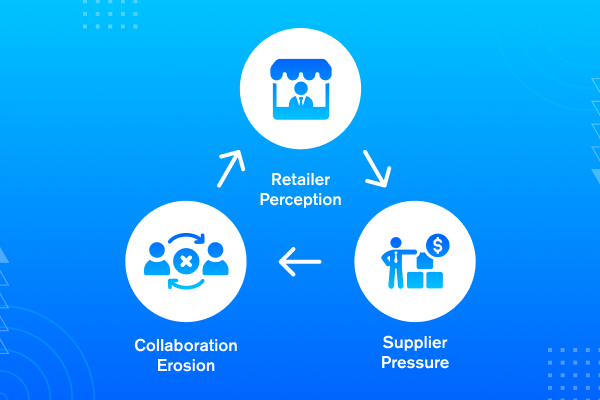
In China’s fast-moving, highly transparent retail environment, the ability to align across these dynamics is becoming a critical driver of performance. Retailers and suppliers that define clear roles, coordinate investment, and operate with shared objectives are better positioned to navigate complexity and unlock sustainable growth. Those that do not risk fragmentation—where decisions made in isolation weaken impact, limit differentiation, and erode long-term partnership value.
Understanding where alignment is strongest, and where it is breaking down, is the first step toward building more effective, resilient partnerships.
Access the full Advantage China Perspective report to explore complete findings and gain deeper insight into how these forces are reshaping collaboration—and how to align your organization for sustainable growth.