.svg)

A five-part thought leadership series on the future of retail media, and retailer-supplier partnerships.
When I arrived in Vienna for this year's Consumer Goods Forum Global Summit, I expected retail media to be one of the dominant conversations. It was. Alongside leaders from Mars, Loblaws, and L-Founders, I joined a discussion about what comes next for retail media. The conversation quickly centred on why retail media continues to capture less than 10% of the CPG marketing investment represented in our research, despite being projected to grow from $155 billion to $175 billion by 2028.
What I didn't expect was how quickly the conversation, both on stage and off it, moved beyond retail media itself.
Whether I was on that panel, listening to leaders debate AI and consumer behaviour, or speaking with retailers and suppliers between sessions, I kept hearing the same underlying question: is our industry evolving quickly enough for what comes next?
That struck me because, for much of the past decade, this space has been defined by growth. Investment has accelerated, networks have expanded, and retailers have rightly recognised it as an increasingly important commercial capability.
But growth has a way of changing the questions we ask.
The debate is no longer whether the opportunity matters. That argument has largely been won. The debate on our panel, and the one that mattered more, was why, with $100 billion in combined CPG budgets represented in our own research, less than 10% of it is actually reaching retail media. The real question is whether the operating model that brought us this far is capable of taking us any further.
That, more than anything else, was my takeaway from the CGF Global Summit.
To me, that's why this industry is at a turning point, and the real work of adapting to it is only just beginning.
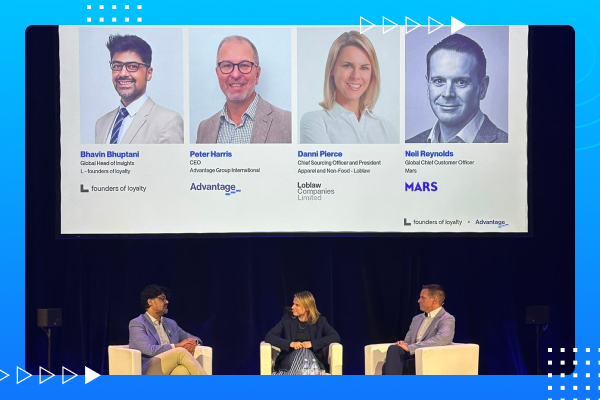
Industry leaders discuss the future of retail media during a panel at the Consumer Goods Summit in Vienna.
Growth Has Changed the Questions
Long before the summit, we'd been seeing the same pattern emerge in our own work with retailers and suppliers around the world; one where the ambition for retail media kept outpacing the operating model behind it. These discussions didn't change my perspective. They confirmed it, and sharpened my sense of how much more urgent that pattern is about to become.
Confidence has become this industry's new currency.
It starts with measurement. I heard it repeatedly in conversations with suppliers throughout the summit; the appetite to invest is there, but so is the expectation of far greater consistency and transparency before they commit more of their budget.
It extends to where this channel sits in the marketing mix. Too many organizations still treat it as a lower-funnel, conversion-focused line item. That's changing. People on both sides of the table increasingly see its future differently, earning a place in brand planning, not just trade discussions.
And it requires rethinking how retailers and suppliers work together in the first place, moving commercial, marketing, and media teams out of separate conversations and into one shared growth agenda.
What's changed is the environment around these challenges.
Artificial intelligence surfaced in almost every discussion throughout the summit, not simply as another technology trend, but as evidence that many of the assumptions underpinning our industry are beginning to shift. I kept coming back to one idea in particular, including on our own panel: agentic commerce, or AI systems capable of researching, evaluating, and increasingly acting on behalf of consumers, without ever seeing a sponsored listing or browsing a retailer's site.
This channel was built on the simple premise that you reach a human being at a moment of high purchase intent. Agentic commerce disrupts that premise directly. If an agent is given an instruction like "plan my weekly shop and keep it under budget" and executes it based on structured product data rather than brand storytelling, then the audience is, in part, becoming a machine. Whether that shift happens over two years or ten is almost beside the point. What matters is the direction of travel, and it's already underway.
Why AI changes the conversation
For me, the significance of agentic AI isn't that it creates entirely new challenges. It's that it takes the same four patterns we've been tracking for years and runs them at machine speed. A measurement gap becomes harder to close when agents don't trigger the pixels our attribution models depend on. A lower-funnel trap becomes more binding when agents optimise for utility, not emotion. An uneven partnership becomes a more permanent one, when the retailer with better data simply wins by algorithmic default.
That's why I don't believe the biggest challenge here is technology. Nor do I believe it's investment. It's evolution, and the next competitive advantage will come from how quickly retailers and suppliers can adapt the operating model underneath this channel, not from the size of a network or the sophistication of a tech stack.
That's what left the strongest impression on me over those three days. Not any single presentation or panel, but the sense that our industry is entering a different phase, and that retail media was simply where I saw it first.
Across three days, the same broader questions kept resurfacing in different rooms, on different stages: how AI is reshaping the mechanics of commerce, how retailers around the world are adapting at very different speeds, and how retailers and suppliers will need to work differently to succeed in what comes next. Those are the questions I want to explore over the coming weeks, because I suspect they'll shape not just the next chapter of retail media, but the future of retailer–supplier partnerships more broadly.